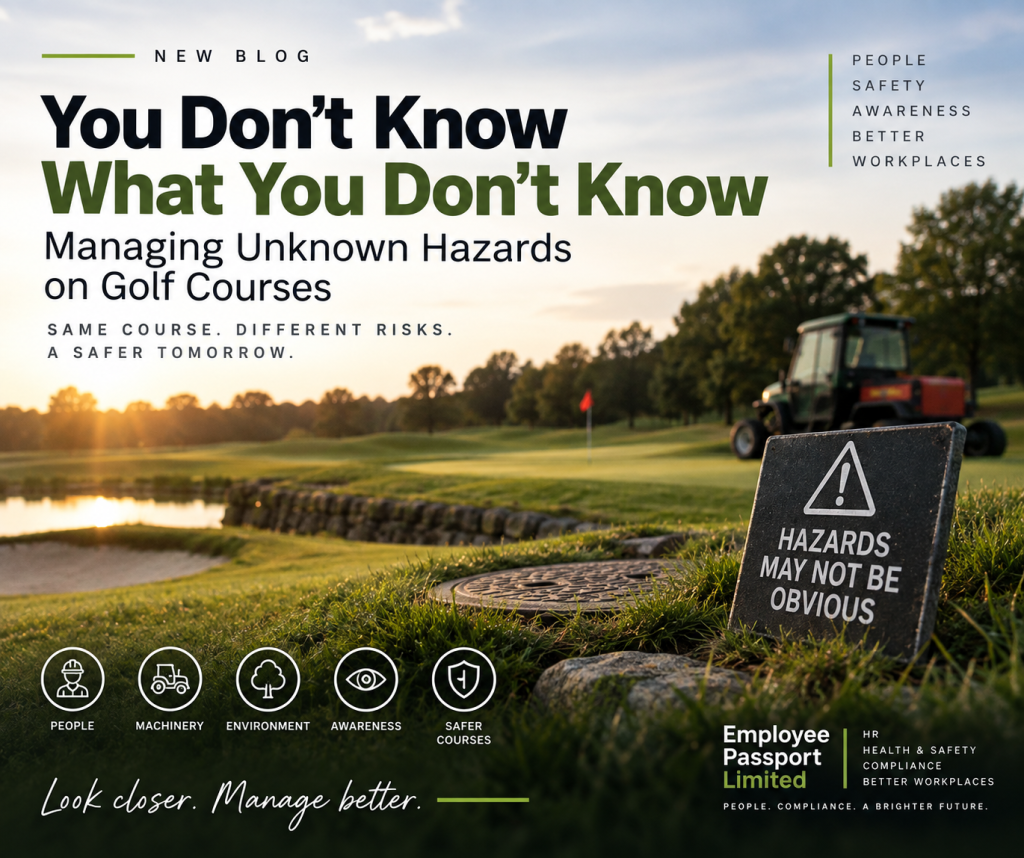
Golf Course Risk Assessment: You Don’t Know What You Don’t Know
Walk onto a golf course and most people see fairways, greens, bunkers, trees and water.
I see something else as well.
A workplace.
And like any workplace, a golf course contains risks that are obvious and risks that are much harder to see.
Machinery. Vehicles. Contractors. Members of the public. Uneven ground. Water. Chemicals. Trees. Changing weather. Underground services. Drainage systems. Irrigation. Early-morning maintenance. Lone working.
Some hazards will be well known.
Others may have been sitting there for years without anybody really questioning them.
That is why a proper golf course risk assessment matters.
You cannot properly control a hazard you have never identified.
Golf Course Health and Safety Starts with Knowing the Ground
One of the biggest dangers in any workplace is familiarity.
“We’ve always done it this way.”
“Everyone knows that’s there.”
“The greenkeepers know about it.”
“That drain has been there for years.”
Perhaps they do know.
But does the new starter?
Does the temporary worker?
Does the contractor?
Does the person operating machinery at six o’clock on a dark winter morning?
Knowledge that exists only inside somebody’s head is not a reliable control measure.
The Health and Safety Executive makes the principle clear. Employers should identify what could cause injury or illness, consider who may be harmed and take sensible action to control the risk.
HIDDEN HAZARDS
Mention “golf course hazards” and most golfers immediately think of bunkers and water.
Those are hazards within the game.
Health and safety hazards are different.
- Uneven or collapsing ground
- Damaged paths
- Slippery banks
- Hidden drainage chambers
- Tree roots
- Damaged or unstable trees
- Low branches
- Concealed holes
- Underground electrical services
- Irrigation pipework
- Drainage systems
- Utility chambers
- Steep slopes
- Poor visibility
- Moving machinery
- Golf buggies and workplace vehicles
- Chemicals and fuels
- Maintenance operations while golfers are on the course
The golf greenkeeper occupational standard maintained by Skills England shows just how broad the role can be. Greenkeepers may be dealing with machinery, drainage, irrigation, lakes, ponds, waterways, chemicals, environmental management, golfers, visitors and contractors.
A golf course is not a static environment.
Your Golf Course Risk Assessment Has to Match Reality
A golf course risk assessment should not be produced simply to prove that a document exists.
It needs to reflect what is actually happening on the course.
Golf-course conditions change constantly.
Heavy rain can turn solid ground into unstable ground.
Storms can damage trees.
Vegetation can restrict visibility.
An irrigation leak can change a surface.
Maintenance operations can affect routes around the course.
Temporary works can introduce excavations and new machinery.
Competitions can dramatically increase the number of people moving around the site.
A risk assessment may have been perfectly suitable when it was completed.
That does not automatically mean it remains suitable today.
A green tick on a system is useful evidence. It is not proof that the ground outside is safe.
Machinery Safety on Golf Courses
Golf-course maintenance relies heavily on machinery.
Ride-on mowers, tractors, utility vehicles, aerators, strimmers, chainsaws and specialist turf equipment are part of normal greenkeeping operations.
That machinery brings risk.
But machinery safety on a golf course is about much more than servicing equipment once a year.
- Is the operator trained and competent?
- Is the machinery suitable for the task?
- Are guards and safety devices working?
- Is maintenance properly recorded?
- Are ground conditions suitable?
- Is there an overturn risk?
- Could another employee, golfer or visitor enter the working area?
- Has the task changed because of weather or ground conditions?
These are practical questions.
And practical questions prevent accidents.
Workplace Transport Risk on Golf Courses
One area that deserves particular attention is workplace transport safety.
Think about everything that can move around a golf facility.
Greenkeeping vehicles. Tractors. Utility vehicles. Golf buggies. Delivery vehicles. Contractor vehicles. Cars.
Now add people.
Employees. Golfers. Visitors. Contractors. Members of the public.
Then add blind corners, undulating ground, vegetation, reversing movements, poor light and changing weather.
The risks become obvious very quickly.
On a golf course, complete separation between vehicles and people may not always be possible.
That does not mean the risk should be ignored.
It means it needs managing.
Contractors Cannot Manage Hazards They Have Not Been Told About
A contractor may be excellent at their trade.
That does not mean they understand your golf course.
Do they know where underground services are?
Do they know where irrigation runs?
Do they know which routes maintenance vehicles use?
Do they know where golfers regularly cross?
Do they know which ground becomes unstable in wet weather?
Do they understand when and where machinery will be operating?
A competent contractor can only manage the risks they know about.
Good contractor management means sharing relevant information before work begins.
Underground Services: What Don’t You Know?
Many golf clubs have existed for decades.
Course layouts change.
Drainage gets installed.
Irrigation gets upgraded.
Electrical systems are extended.
Buildings appear and disappear.
Contractors change.
Course managers retire.
Greenkeepers move on.
How complete are your records?
Do you actually know what sits beneath every area where future excavation or ground works could take place?
If the answer is “we think so”, I would want to look again before somebody starts digging.
Check available plans.
Speak to experienced staff.
Consult previous contractors where appropriate.
Use suitable survey or detection methods when required.
When something new is discovered, record it properly.
Do not allow important safety knowledge to disappear again.
Near Miss Reporting Is Free Information
A buggy nearly overturns.
A mower drops into an unexpected depression.
Someone almost falls into an obscured chamber.
A contractor narrowly avoids striking a service.
A golfer unexpectedly enters an active maintenance area.
Nobody gets hurt.
It is tempting to shrug and move on.
Don’t.
A near miss is information.
The workplace has just shown you where something could go wrong without making you pay the full price of an accident.
Ask why it happened.
Ask what controls failed.
Ask whether anyone else has experienced the same issue.
Then record it and do something about it.
Seasonal Golf Course Risk Assessments Matter
A golf course in January is not the same workplace as the same course in July.
Winter can bring mud, flooding, ice, poor visibility, storms, damaged trees and unstable surfaces.
Summer may mean heat, increased golfer numbers, extended working hours, dry ground and greater pressure on maintenance teams.
Autumn brings falling leaves, reduced daylight and changing surfaces.
Spring often brings increased maintenance activity.
That does not mean rewriting every risk assessment four times a year.
It means recognising meaningful change.
Risk management should respond to the real environment.
Ask the Greenkeepers
If you want to know where the hidden risks are, ask the people working on the course.
An experienced greenkeeper will often know exactly where water collects.
They will know which slopes cause problems for machinery.
They may know where old drainage runs.
They will know which areas golfers regularly enter despite instructions.
They will probably know where they have experienced a near miss.
That information has real value.
Good leadership is not pretending you know everything.
Good leadership is making sure people are confident enough to tell you what you don’t know.
Record What You Learn
Finding the hazard is only half the job.
What happens next matters.
If there is an underground service, record it.
If an area becomes unstable in wet weather, document it.
If a vehicle route creates repeated near misses, review it.
If a contractor discovers previously unknown infrastructure, update your information.
If machinery should not enter a particular area under certain conditions, make that clear.
If somebody identifies a new risk, make sure ownership for the action is visible.
This is where technology can support better health and safety without replacing human judgement.
Employee Passport was built around that principle: putting records, actions, deadlines, documents, training and compliance information into one clearer system.
Good Health and Safety Is Not About Stopping the Job
I have never believed health and safety should be about finding reasons why work cannot happen.
A golf course still has to operate.
The greens still need cutting.
Drainage still needs repairing.
Trees still need maintaining.
Contractors still have jobs to complete.
Golfers still want to play.
The aim is not to eliminate every element of risk from life.
The aim is to understand significant risks and manage them properly.
Good risk management should help the business operate.
Poor compliance creates paperwork.
Good compliance creates clarity.
There is a big difference.
Want to See How Employee Passport Can Help?
If your golf club, grounds-maintenance business or organisation is still managing risk assessments, training records, compliance actions and Health & Safety documents across paper files, spreadsheets and separate systems, there is a simpler way to keep control.
Employee Passport brings HR, Health & Safety, training, documents, actions and compliance records into one place, with clearer ownership and a stronger audit trail.
Because compliance should not simply prove somebody completed a risk assessment.
It should help make sure somebody gets home safely.