
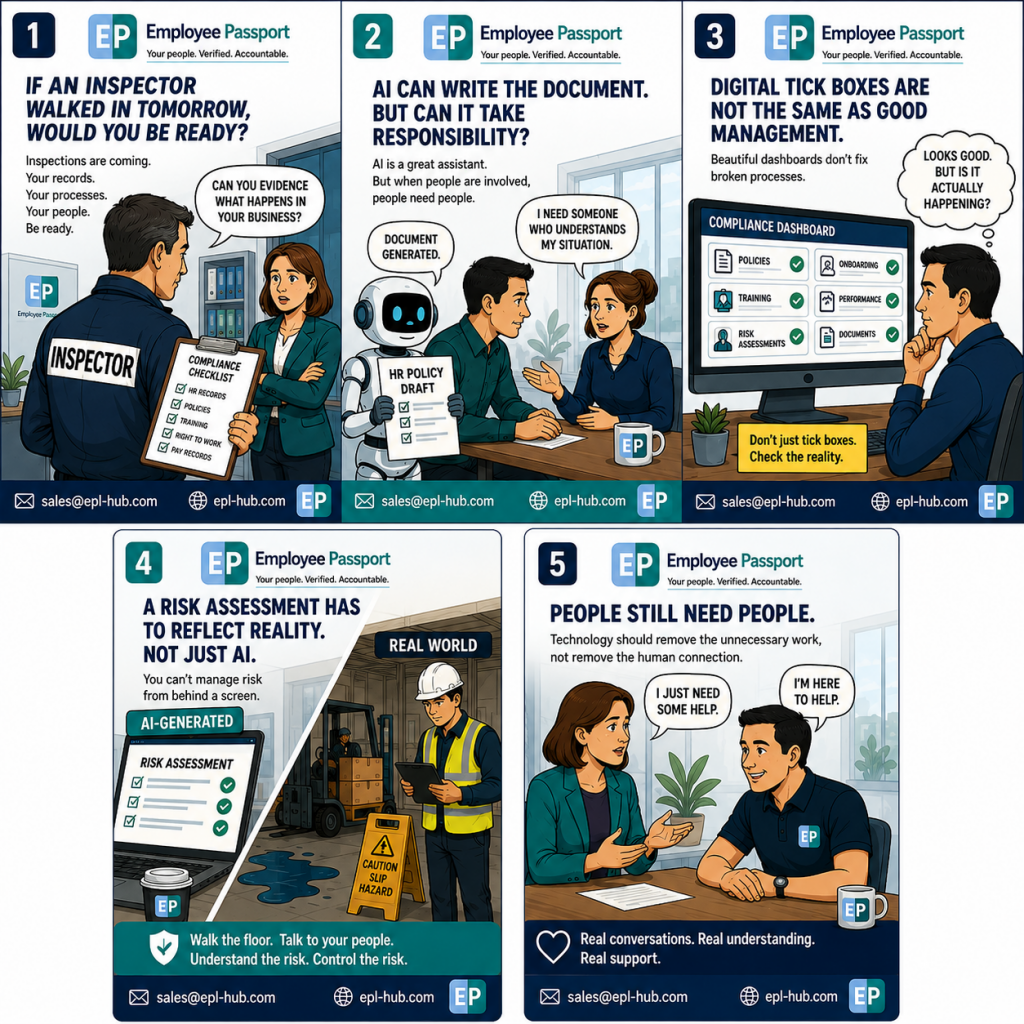
Workplace Compliance Inspections: Is Your Business Ready?
This topic came onto my radar properly this month when one of the businesses we support in Ireland had workplace inspectors arrive to carry out compliance checks.
It was a useful reminder that compliance is not really about what you can produce after somebody gives you a week’s notice.
It is about what you can show there and then.
Are your employment records in order? Are the processes you say you follow actually being followed? Can managers explain what happens when somebody joins, goes off sick, raises a concern or needs support? Can you demonstrate what you are doing about Health & Safety risk?
That experience got me thinking about the direction of travel in the UK too, and about something else I am seeing more and more often: businesses trying to move quickly with AI and automation without always stopping to ask whether the technology reflects what is really happening with their people.
I am very much in favour of using AI.
But there is an important difference between using AI to help with the work and assuming the work has been done simply because a document now exists.
That distinction is becoming increasingly important.
If an inspector arrived tomorrow, what could you actually prove?
Ireland already has a well-established inspection regime through the Workplace Relations Commission.
The WRC says its Inspection Services carry out workplace compliance inspections, work with employers to address breaches and, where necessary, can issue notices or bring legal proceedings. Its employer guide also makes clear that inspections may be arranged in advance or unannounced.
That is an important distinction.
An unannounced inspection is not testing whether you are capable of pulling together a good-looking file.
It is testing the way the business operates every day.
In Great Britain, the landscape has also changed. The Fair Work Agency launched on 7 April 2026, bringing a number of labour-market enforcement functions together. Its enforcement policy states that investigations may involve requests for information, inspection of records, interviews with workers or business representatives and visits to business premises. Although visits will generally be arranged in advance, the Agency also has powers to carry out unannounced investigations.
This does not mean every business should suddenly expect somebody at reception tomorrow morning.
It does mean that good record-keeping, clear processes and the ability to evidence what actually happens in the workplace matter.
So I would ask business owners to test themselves before anybody else does.
Could you readily evidence:
employment records and key documents;
onboarding and right-to-work processes;
training and compliance activity;
holiday and sickness records;
the actions taken in an HR case;
who owned an action and whether it was completed;
Health & Safety assessments and controls; and
whether the procedure written down is the procedure people actually follow?
The final point is probably the most important.
Does your documentation reflect reality?
The risk of digital tick-box compliance
Years ago, the cliché was the Health & Safety folder sitting on a shelf gathering dust.
Today, we could create exactly the same problem in a much more sophisticated way.
Everything can look impressive on screen.
Policies uploaded.
Training complete.
Dashboards showing green ticks.
Risk assessments filed.
Automated reminders sent.
Tasks marked complete.
But what happens if the manager has never properly read the policy?
What happens if the risk assessment bears little resemblance to the job?
What happens if an employee has raised an issue but cannot get hold of anybody who understands the situation?
A dashboard can tell you that a task has been completed.
It cannot always tell you whether the task was completed well.
That is why I think businesses need to be careful not to confuse digital evidence with good management.
This is not an argument against technology. Quite the opposite.
Good technology should give us greater visibility. It should stop actions disappearing into inboxes. It should make responsibilities clearer and give employers a better audit trail.
The danger comes when the technology becomes the objective rather than the tool.
At Employee Passport, that idea of clearer ownership sits at the heart of what we are trying to achieve. The platform is designed to bring employee records, onboarding and compliance activity into one place, with clear actions, owners and deadlines.
That should make people management easier.
It should not remove the need to manage people.
AI can write the document. Can it take responsibility?
AI can already do some genuinely useful work for HR and Health & Safety teams.
It can help structure information.
It can create a first draft.
It can summarise notes.
It can identify questions that need to be considered.
It can reduce repetitive administration.
Used in the right way, that can save a huge amount of time.
My concern is what happens when a first draft quietly becomes the final answer.
I am seeing businesses experiment with AI-generated HR documents and Health & Safety material, including risk assessments.
Again, there is nothing inherently wrong with using AI as part of that process.
The question is whether a knowledgeable person has then looked at it and asked:
Does this actually apply here?
That is where human judgement becomes essential.
The same point applies to employee relations.
A chatbot might be able to explain the disciplinary process.
It cannot necessarily understand the history between two people.
It might generate a letter.
It does not know how a manager delivered the conversation.
It may help organise the facts.
It cannot accept responsibility for the decision.
And sometimes an employee simply needs to speak to another human being.
They need somebody who can listen to what is being said, understand what is not being said and apply judgement to the circumstances.
Technology should make that easier to provide.
It should not become a barrier between the employee and the person who can actually help.
A risk assessment has to reflect the real workplace
Health & Safety is probably the clearest example of why documents alone are not enough.
HSE guidance says employers must make a suitable and sufficient assessment of risks to employees and others who may be affected by the work.
HSE describes risk management as a practical process:
identify hazards, assess the risks, control the risks, record the findings and review the controls.
That is very different from asking an AI system to create a generic risk assessment and saving the output into a folder.
A system sitting behind a screen has not walked through your warehouse.
It has not watched somebody carry out the task.
It has not noticed the route people actually take rather than the route shown in the procedure.
It has not seen the damaged floor, awkward storage, blocked access or shortcut somebody uses because the official method does not work in practice.
This is also why competence matters.
HSE says employers must get help from a competent person to meet Health & Safety requirements, describing competence in terms of sufficient training, experience or knowledge and other qualities appropriate to the situation.
So AI can absolutely help a competent person.
What it should not do is create the illusion that competence is no longer required.
If you want support with this side of the business, our HR and Health & Safety services include practical HR support, audits, risk assessments, safe systems of work and compliance activity, alongside the Employee Passport platform.
People still need people
This is probably the point I feel most strongly about.
Businesses are automating quickly.
That makes sense.
But over the last few months I have also heard more frustration from people who cannot get hold of anyone.
They have an HR problem, a Health & Safety question or something sensitive happening at work and the route to support becomes another portal, another chatbot or another automated response.
There are situations where that is fine.
And there are situations where it simply is not.
People management involves context.
There are emotions, personalities, histories, misunderstandings and decisions that can have a serious impact on somebody’s working life.
That does not mean technology has no place.
It means we should be clear about what we are asking technology to do.
Automate the administration. Keep the accountability human.
That balance also reflects why Employee Passport combines systems and structure with practical HR and Health & Safety support.
You can read more about the thinking behind the business on our About Employee Passport page.
What I would review now
I would not wait for an inspection to start checking this.
Choose one employee at random and look at their record from the beginning.
Can you see when they joined, what documentation was completed, what training they received and what actions are outstanding?
Then choose one HR matter.
Can you see what happened, who dealt with it and why decisions were made?
Choose one risk assessment.
Walk the workplace and see whether it still reflects what people actually do.
Ask a manager about one of your policies.
Can they explain how they would apply it in a real situation?
Then ask the people doing the work whether the process works as well in practice as it does on paper.
You may find that everything is exactly where it should be.
You may also find a few cobwebs.
Either way, it is better that you find them first.
The question isn’t “Are we ready for an inspector?”
The better question is:
“Are we managing our people properly every day?”
If the answer to that is yes, inspection readiness becomes a consequence of good management rather than a last-minute exercise.
That is how I think businesses should approach AI as well.
Use it.
Automate the repetitive tasks.
Remove unnecessary administration.
Make information easier to find.
Create reminders and clearer audit trails.
Then use the time you have saved to do the work technology cannot do for you:
talk to your people, understand what is happening, challenge poor practice and take responsibility for the decisions you make.
At Employee Passport, our aim is straightforward: one place for employee records, onboarding, absence, HR activity and compliance, with clearer actions, ownership and evidence. You can explore the full Employee Passport services or visit the Employee Passport website to see how the platform fits together.
If you would like to see it in practice, book an Employee Passport demo.
Insight & sources
The regulatory points in this article draw on current guidance from the Workplace Relations Commission, Fair Work Agency and Health and Safety Executive. The WRC confirms that employment compliance inspections can be announced or unannounced; the Fair Work Agency describes powers including record inspection, interviews and workplace visits; and HSE guidance emphasises suitable risk assessment and competent Health & Safety support.
Further reading:
Workplace Relations Commission — Employer’s Guide to Inspections
Fair Work Agency — Enforcement Policy Statement
Health and Safety Executive — Managing Risks and Risk Assessment at Work
Health and Safety Executive — Competent Help and Worker Consultation
Want to see how Employee Passport could work in your business?
Book a demo and we can show you how employee records, HR actions, Health & Safety activity and compliance evidence can be brought together in one place.
Contact us: sales@epl-hub.com
Employee Passport — Your people. Verified. Accountable.