
Health & Safety Update 2026: A Message From Mark on What Employers Should Review Now
If you are hearing a lot of noise about compliance in 2026, it is easy to assume there must be a major new health and safety law package landing as well.
At the moment, that is not the position for most employers.
There are no major new universal cross-workplace UK health and safety law changes currently affecting most employers in the same way as the recent employment law reforms. HSE’s current forthcoming regulations page points to specific changes and consultations, but not a broad new employer-wide reset for most workplaces.
That said, this is not a reason to switch off.
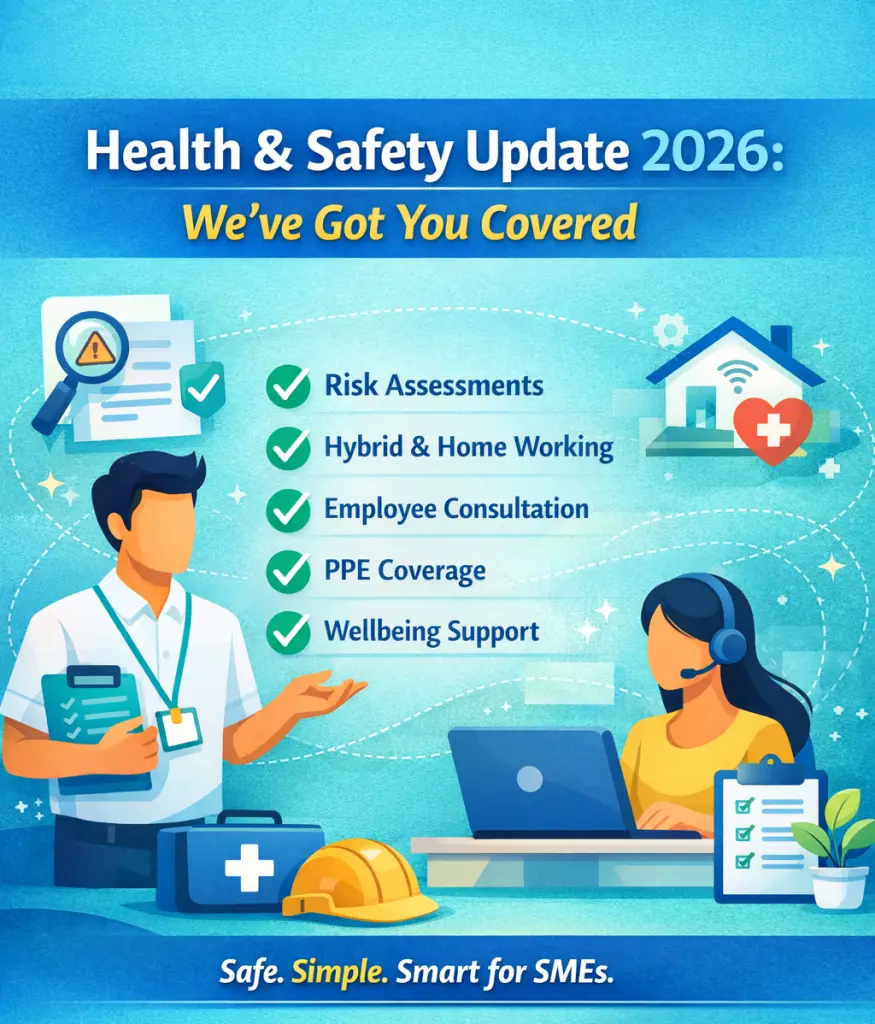
For SMEs in particular, the smarter approach is to stay calm, avoid the scare tactics, and use this period to make sure your current arrangements are still fit for purpose. In practice, that means reviewing your risk assessments, home and hybrid working controls, employee consultation, PPE coverage, and wellbeing support in line with current HSE and Acas guidance.
What employers should do now
This is not about panic. It is about basics done properly.
Review your risk assessments.
Check your home and hybrid working arrangements.
Make sure consultation is happening.
Confirm PPE rules cover the right people.
Keep wellbeing part of your health and safety approach.
The businesses that stay in control are usually the ones that keep things simple: clear owner, clear action, clear deadline, clear record, and clear visibility.
Risk assessments still need active review
What the guidance says
HSE says employers must carry out a “suitable and sufficient assessment” of risks to employees’ health and safety and to others affected by the work. Acas also says employers should review risk assessments regularly to keep working environments safe and healthy.
Acas further advises employers to keep their health and safety policy under review, include health and safety in induction, and communicate changes to safety measures clearly to staff.
What employers should do
Review
Check whether your current risk assessments still reflect how work is actually being done now, not how it was done a year ago.
Update
Where risks, locations, equipment, workloads or working patterns have changed, update the controls and record what action was taken.
Accountability
Give each review an owner, set a deadline, and keep an evidence record of the updated assessment and resulting actions.
Hybrid and home working still carry full health and safety duties
What the guidance says
HSE is clear that employers have the same health and safety responsibilities for people working at home as for any other worker. This includes long-term home workers and those in hybrid arrangements. HSE also says your risk assessment must cover home workers, while keeping the approach balanced and proportionate.
Acas also confirms employers remain responsible for employees’ health, safety and wellbeing when they work remotely.
What employers should do
Home working risks
Make sure your risk assessment process covers display screen equipment, working environment, equipment use, and any practical issues linked to working from home. HSE says employers must take reasonable steps to make sure home workers have a safe place to work.
Hybrid arrangements
Review whether hybrid working patterns have introduced new risks around lone working, communication gaps, workstation setup, workload or supervision. This is an inference from HSE’s requirement to assess home-working risks and Acas guidance on remote health, safety and wellbeing.
Visibility
Managers need visibility of the process so employees know how to raise issues and get them resolved quickly.
Consulting employees on health and safety still matters
What the guidance says
Both HSE and Acas stress the importance of involving workers in health and safety matters. Acas says employers and workers should talk openly about risks and safety measures, while HSE emphasises involving your workforce as part of effective health and safety management.
What employers should do
Share
Make sure employees know what risks have been identified and what control measures are in place.
Consult
Discuss changes to working arrangements, safety procedures, equipment, and site or home-working expectations before issues escalate.
Record
Keep a simple record of consultations, agreed actions and who is responsible for follow-through.
This is one of the biggest differences between paperwork and real control. A policy on its own is not enough. People need to know what has changed, what they need to do, and who owns the next step.
PPE duties still need to reflect the wider worker definition
What the guidance says
One change that still matters is the expanded PPE duty introduced on 6 April 2022, which widened PPE responsibilities beyond employees to include many limb (b) workers. HSE’s current PPE guidance says employers must protect workers from health and safety risks and provide PPE free of charge where a risk assessment shows it is needed.
What employers should do
Check coverage
Review who your PPE arrangements apply to. Do not assume they only cover traditional employees.
Check issue and replacement processes
Make sure there is a clear process for issuing, replacing and recording PPE.
Evidence
Keep evidence that PPE has been provided where required, and that expectations around use, training and checks are clear.
Wellbeing should still sit inside the health and safety conversation
What the guidance says
HSE says employers are required to prevent physical and mental ill health arising from work activities. Risk assessment is part of that duty. HSE also highlights occupational health support where work-related health risks remain or specialist advice is needed.
CIPD’s current wellbeing material supports a broader and more strategic approach to employee wellbeing. Its wellbeing factsheet says the role of employers is to help create the conditions for good wellbeing at work, and its 2025 health and wellbeing reporting continues to push employers beyond purely reactive absence management.
What employers should do
Do not treat wellbeing as separate
Wellbeing should not sit in a completely different box from health and safety. Workload, management style, working environment and stress all affect risk. This is an inference from HSE’s focus on preventing mental ill health from work and CIPD’s broader wellbeing model.
Support managers
Managers need practical guidance on spotting issues early, responding properly, and escalating concerns when needed.
Build a proper approach
The best systems are proactive, not reactive. They help you spot issues, record action, and keep visibility across the business.
What this means for SMEs in 2026
This is the point I would make clearly.
Do not get pulled into the idea that because there is no big new health and safety law headline, there is nothing to do.
But equally, do not let anyone convince you this needs to become a huge, overcomplicated project.
For most SMEs, the sensible approach is:
1. Review what you already have
Look first at policies, risk assessments, induction content, home-working arrangements and consultation processes.
2. Make sure reality matches the paperwork
A lot of businesses have documents that say one thing and working practices that say another. That gap is where risk grows. This is an inference based on the employer duties set out by HSE and Acas.
3. Assign ownership
Every review needs an owner, every fix needs an action, every action needs a deadline, and every completed step needs a record.
4. Keep it visible
Managers and employees need to know what is expected, what has changed, and where to raise concerns.
Suggested wording for employers
You could position it like this:
“While there are currently no major new universal UK health and safety law changes affecting most employers in the same way as recent HR reforms, the business should review and refresh its current arrangements in line with HSE and Acas guidance. In particular, this includes ensuring risk assessments are up to date, home and hybrid working risks are covered, employees are consulted on any safety changes, PPE responsibilities reflect the wider worker definition, and wellbeing support remains part of our overall health and safety approach.”
Final thought from Mark
Health and safety works best when it is not treated as a box-ticking exercise.
It should be clear.
It should be practical.
And it should be visible.
For SMEs, this is not about overcomplicating things. It is about keeping good records, making sensible updates, involving people properly, and making sure responsibility is clear.
That is how you reduce risk without adding chaos.
Need a simpler way to keep employee records, onboarding, training, compliance actions and key documents in one place?
Book a demo of Employee Passport to see how your team can keep clearer records, assign actions, improve visibility and stay on top of people-related compliance with less admin.
References and further reading
- HSE: Forthcoming regulations
- Acas: Keeping everyone safe – Health and safety at work
- Acas: Risk assessments
- Acas: Reporting a risk
- Acas: Health and wellbeing at work
- HSE: Managing home workers’ health and safety
- HSE: Home working
- HSE: Managing risks and risk assessment at work
- HSE: Using personal protective equipment (PPE) to control risks
- HSE: Occupational health and health surveillance overview
- CIPD: Wellbeing at work factsheet
- CIPD: Health and wellbeing at work 2025
Need a simpler way to keep employee records, onboarding, training, compliance actions and key documents in one place?
Book a demo of Employee Passport to see how your team can keep clearer records, assign actions, improve visibility and stay on top of people-related compliance with less admin.