
Employee Passport / Hospitality / Health and safety
Preventing slips in restaurant kitchens during service
Review how your kitchen responds to spills, keeps access clear and follows up recurring problems during busy service.
By Mark Whitfield · 28 October 2026
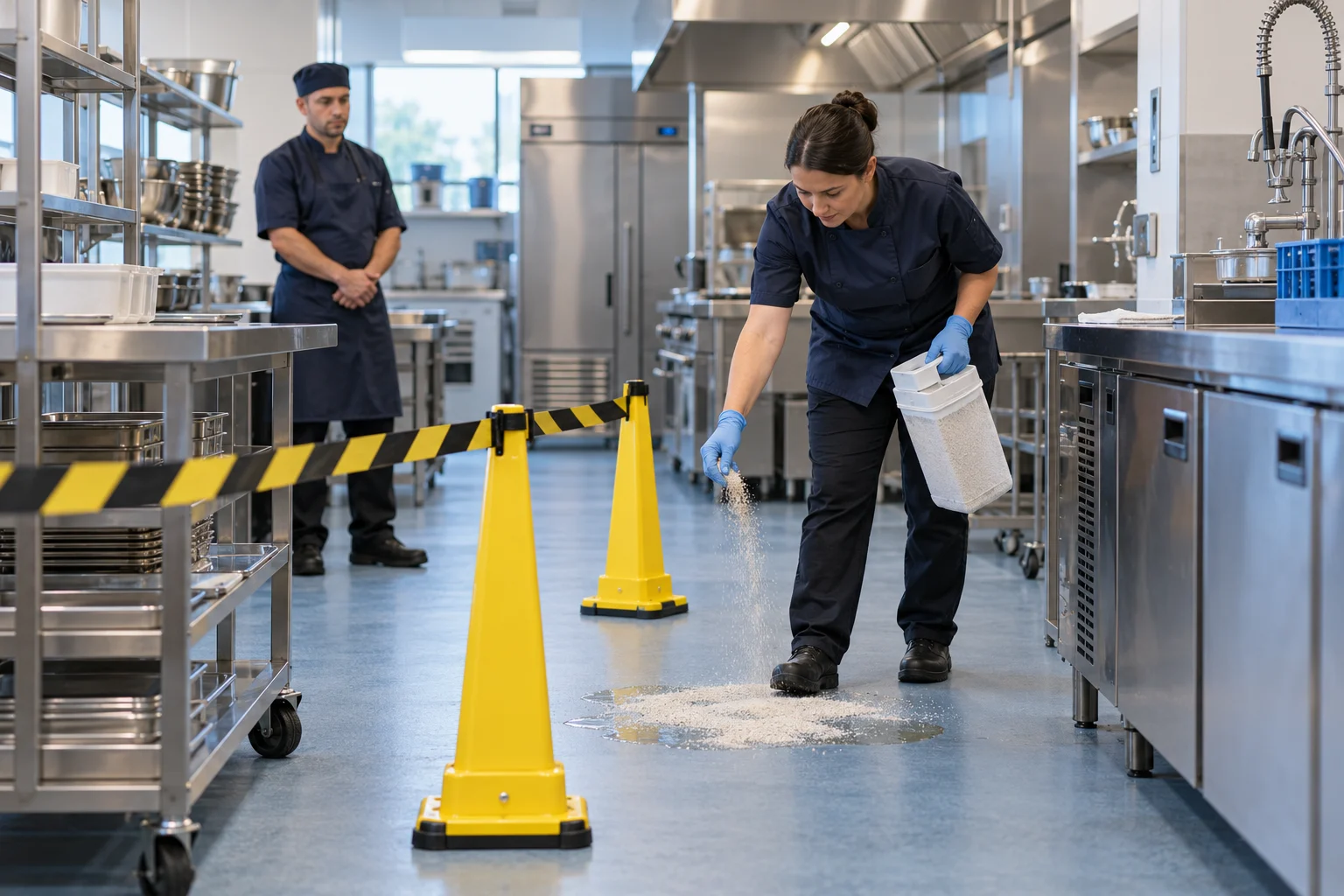
A spill can become a serious hazard quickly when kitchen staff are carrying hot food and concentrating on orders. Review how the kitchen stays safe while service continues. The relevant question is whether people can deal with contamination promptly without creating another hazard.
Identify where contamination comes from
Check washing areas, food preparation points and the route between the kitchen and restaurant. Look at equipment leaks, deliveries and cleaning methods. Ask colleagues which areas become slippery at the busiest times.
Agree a response that works during service
HSE highlights food spillages as a cause of kitchen slips. Set out who responds, how the affected area is kept clear and how cleaning is completed safely. Review the flooring and footwear as part of the wider assessment. A warning sign alone leaves the contamination in place.
Check the routine at closing time
Cleaning can introduce its own slip risk. Review the order of work and access while floors are wet. Where a leak or damaged surface persists, assign a repair action and a temporary arrangement. Verify that the fix works before removing the restriction.
Practical checklist
Check spill response, floor condition, leak reporting, safe cleaning and the routes staff use with hot items. Include both the service period and the close-down routine.
Give the service briefing a specific question
Ask which area caused difficulty on the previous service and what has changed since then. A brief question about the washing area or pass is more useful than a general reminder to be careful. Name the person taking forward an outstanding issue and make the immediate arrangement clear to the team. Confirm the arrangement with colleagues arriving later in the shift.
An example of a useful follow-up record
Suppose the team reports repeated wet flooring near the pot-wash area. The manager records the location, when it occurs and the action needed to investigate the source. An agreed temporary arrangement remains in place while the issue is addressed. At the next service briefing, the manager checks whether the reported problem has stopped. This example illustrates a process; it is not a client incident or an instruction to continue unsafe work.
Review the action with the people using the kitchen
A repair marked complete in an email is a useful update, but the team still needs to know the current arrangement. Ask the closing team and the early team whether the same problem has reappeared. Keep the finding and any next action together so another manager can pick it up without repeating the investigation. Use near-miss reports as prompts to check the process, rather than waiting for someone to be injured.
Can training solve a recurring leak?
Training helps people respond, but the source also needs a repair or another effective control.
Related EPL support
For advice shaped around your workplace, see support for hospitality organisations.
External reference
Read HSE guidance for the activity alongside the practical steps above.
Need help applying this?
Need help applying this in your hospitality organisation? Explore EPL health and safety support or contact the team to discuss the work you need help completing.