
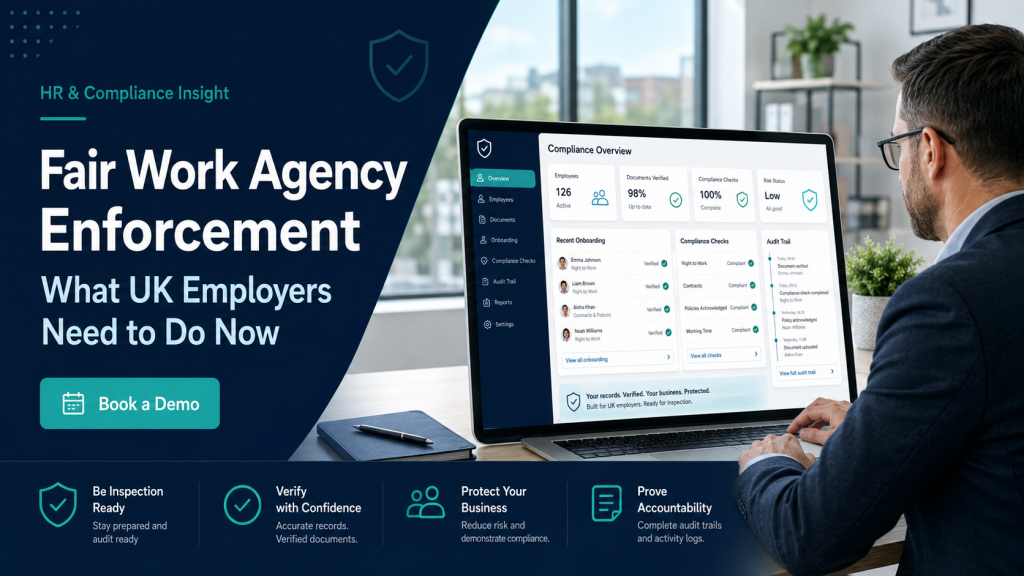
The Fair Work Agency is now a significant part of the UK’s employment compliance landscape, and employers should understand what its enforcement approach means in practice.
The Government published its Fair Work Agency Enforcement Policy Statement in April 2026, setting out how the agency will enforce labour market legislation, investigate potential breaches and use its civil and criminal enforcement powers. The statement was most recently updated in May 2026.
For employers, the message is straightforward: compliance needs to be more than a set of policies sitting in a folder.
Businesses increasingly need to be able to demonstrate that their employment practices are being followed, their records are accurate and their responsibilities are being managed.
What is the Fair Work Agency?
The Fair Work Agency brings together a number of labour market enforcement functions within one organisation.
Its remit includes areas such as National Minimum Wage and National Living Wage compliance, employment agency standards, gangmaster licensing, serious labour exploitation and enforcement relating to unpaid Employment Tribunal awards and Acas settlements.
Its stated purpose includes protecting workers’ rights, securing compliance with labour market legislation and preventing compliant employers from being undercut by businesses that fail to follow the law.
That matters to businesses of every size.
The question is no longer simply:
“Do we have the right policies?”
A better question is:
“Could we demonstrate that we are actually following them?”
How can the Fair Work Agency investigate employers?
This is where employers need to pay particular attention.
According to the Government’s enforcement statement, potential non-compliance can come to the Fair Work Agency’s attention through worker complaints, referrals from public bodies, intelligence from partner organisations, proactive compliance activity and analysis of data and risk indicators.
Investigations can involve:
requests for information;
inspection of employment records;
interviews with workers or business representatives;
written enquiries;
visits to business premises; and
examination of digital records.
The Fair Work Agency can require specified information or documents to be provided by a particular date. Although businesses will generally be contacted in advance of a site visit, the enforcement statement confirms that unannounced investigations are also possible.
That creates an important distinction between being compliant and being inspection ready.
Would your employment records stand up to scrutiny?
Imagine receiving a request tomorrow for evidence relating to your workforce.
How quickly could you produce:
employee contracts and employment documentation?
signed policies and confirmation employees have read them?
onboarding records?
working-time and attendance records?
holiday and absence information?
pay-related documentation?
evidence of actions raised and completed?
employee communications?
documentation showing who was responsible for particular HR actions?
For many SMEs, the information exists, but it exists across emails, spreadsheets, filing cabinets, shared drives and individual managers’ computers.
That creates unnecessary risk.
Good compliance isn’t just about producing a document after something has gone wrong. It is about creating a clear record of what happened, when it happened, who was responsible and what action was taken.
Technology helps, but it doesn’t replace accountability
Digital HR systems can make compliance considerably easier.
Employee Passport allows businesses to bring employee records, documents, onboarding, absence, tasks and compliance activity together in one place.
But technology should support good management rather than create the illusion of it.
A system cannot replace management responsibility, sound HR advice or proper decision-making.
What it can do is provide the structure and evidence behind those decisions.
That becomes increasingly valuable when a regulator, solicitor, employee or tribunal asks:
“Can you show me?”
What should employers do now?
Employers do not need to panic because of the Fair Work Agency.
They should, however, use its enforcement policy as a reason to review how employment compliance is actually managed.
Start by checking whether employee records are complete, whether policies are current, whether employees have acknowledged key documents and whether HR actions can be evidenced.
Look at where your information is stored and whether it could be retrieved quickly if an enforcement officer requested it.
Most importantly, identify the difference between having a process written down and having evidence that the process is actually being followed.
The Government’s full Fair Work Agency Enforcement Policy Statement is available on GOV.UK and is worth reviewing as part of that exercise.
Is your business inspection ready?
Employee Passport combines employee management software, practical HR support and Health & Safety support to help UK SMEs manage their people, records and compliance more effectively.
Instead of employment information being scattered across different systems, Employee Passport provides a clearer central record of the documents, actions and responsibilities surrounding your workforce.
If you want to see how Employee Passport could help your business become better organised, better evidenced and more inspection ready:
Book a Demo and see Employee Passport in action.