
The Law Is Moving. Is Your Business Ready?
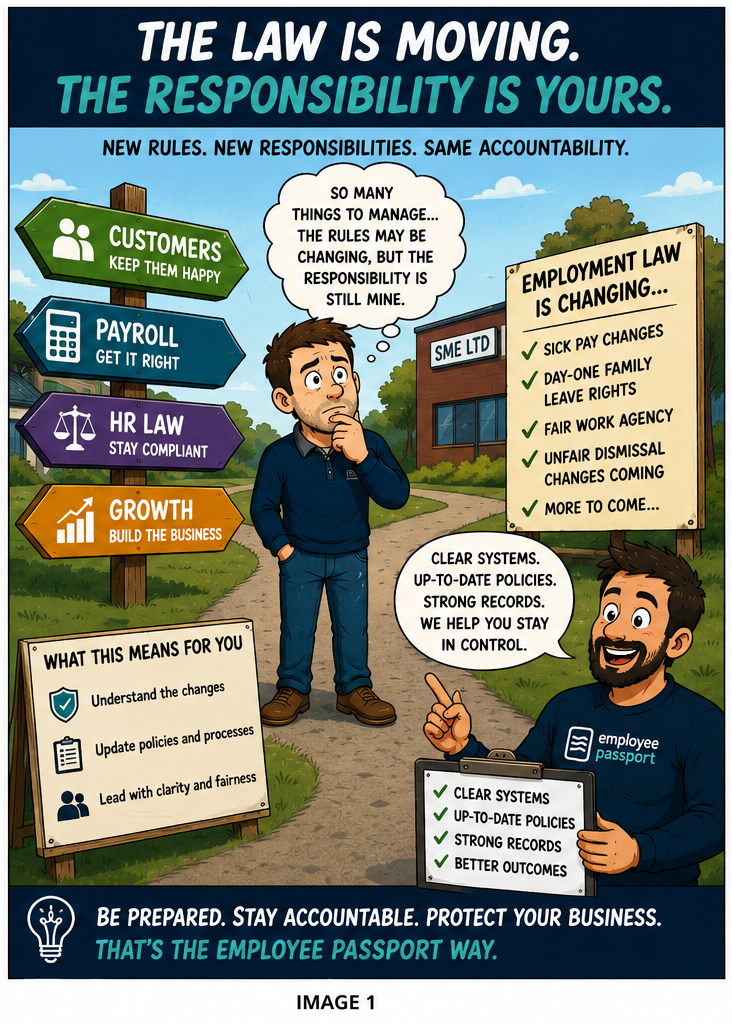
Let’s be honest. Most SME owners did not start a business because they wanted to become employment-law experts.
They started with an idea. They saw an opportunity, understood their market and believed they could build something worthwhile. Their focus was customers, cash flow, service and growth.
But employing people brings responsibility.
The political debate around employment reform will continue. Some will argue that the changes give working people greater security. Others will warn about increased costs, reduced flexibility and the impact on recruitment.
SME owners can have their own view. What they cannot do is ignore the changes.
The Employment Rights Act 2025 has introduced a substantial programme of employment reform. Some measures are already in force, while others will follow through the remainder of 2026 and into 2027 (UK Government, 2026a; CIPD, 2026a).
Here is the reality: Westminster makes the law, but employers remain accountable for putting it into practice.
What has already changed?
From 6 April 2026, Statutory Sick Pay became payable from the first full day of sickness absence. The previous lower earnings threshold was removed, meaning more lower-paid and part-time employees can qualify. Payment is now calculated at 80% of average weekly earnings or the statutory weekly rate, whichever is lower (Acas, 2026a; UK Government, 2026b).
Paternity leave and unpaid parental leave also became day-one employment rights from April 2026. This means eligible employees no longer need to complete a qualifying period of service before becoming entitled to take the leave, although separate eligibility rules may still apply to statutory pay (Acas, 2026b; UK Government, 2026c).
The Fair Work Agency was launched in April 2026, bringing a stronger and more coordinated focus to the enforcement of workplace rights (UK Government, 2026d).
These are not changes that should sit in an email inbox marked “deal with later”.
They affect payroll, absence procedures, family-leave policies, employment contracts, management training and record-keeping.
Accountability question
Can your managers explain the current sickness and family-leave rules confidently and apply them consistently?
If the answer is no, the business has work to do.
Unfair dismissal protection is the next major test
From 1 January 2027, the qualifying period for ordinary unfair dismissal protection is due to reduce from two years to six months. The cap on compensatory awards for unfair dismissal is also due to be removed (UK Government, 2026a; Acas, 2026c).
It is important to be accurate here. The new six-month period does not mean that employees currently have to wait six months before every type of claim can be brought.
Protection against discrimination and many automatically unfair reasons for dismissal already applies without a two-year qualifying period. Employers should therefore follow a fair and properly documented process regardless of an employee’s length of service (Acas, 2026c; UK Government, 2026e).
However, the reduction to six months will significantly increase the importance of early employment management.
Recruitment decisions will matter more.
Inductions will matter more.
Probation reviews will matter more.
Performance conversations will matter more.
Written evidence will matter more.
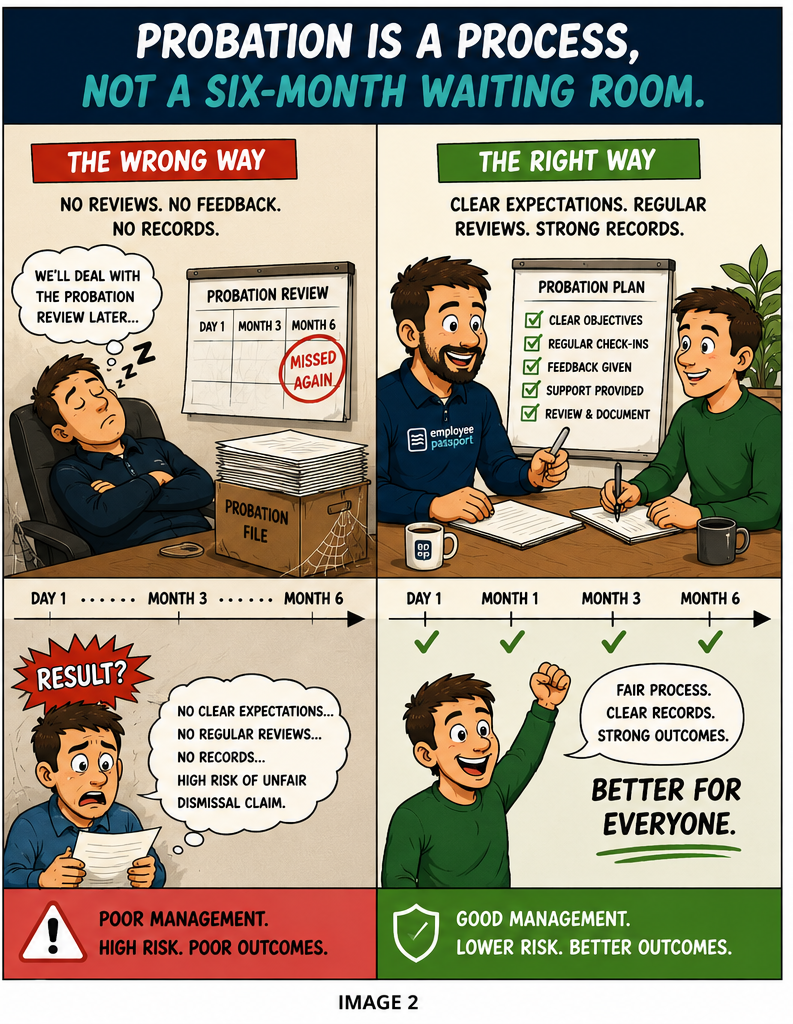
Too many businesses treat probation as a date in the diary rather than a management process.
An employee joins. Everybody gets busy. Objectives remain vague. Concerns are mentioned in passing, but nothing is recorded. The probation meeting gets postponed. Then, five or six months later, somebody decides the employee is “not the right fit”.
That is not management.
A probation period should be active, fair and structured. Expectations should be explained from the beginning. Progress should be reviewed regularly. Concerns should be raised early, evidence should be recorded and appropriate support should be provided.
As CIPD guidance indicates, the forthcoming changes make effective probation management increasingly important for employers. Anyone recruited from July 2026 could potentially acquire ordinary unfair dismissal protection from January 2027 after reaching six months’ service (CIPD, 2026b).
People deserve clarity.
Good leadership is not about keeping concerns quiet and then surprising somebody with a dismissal. It is about setting standards, communicating honestly and following through.
Evidence must come before assumption
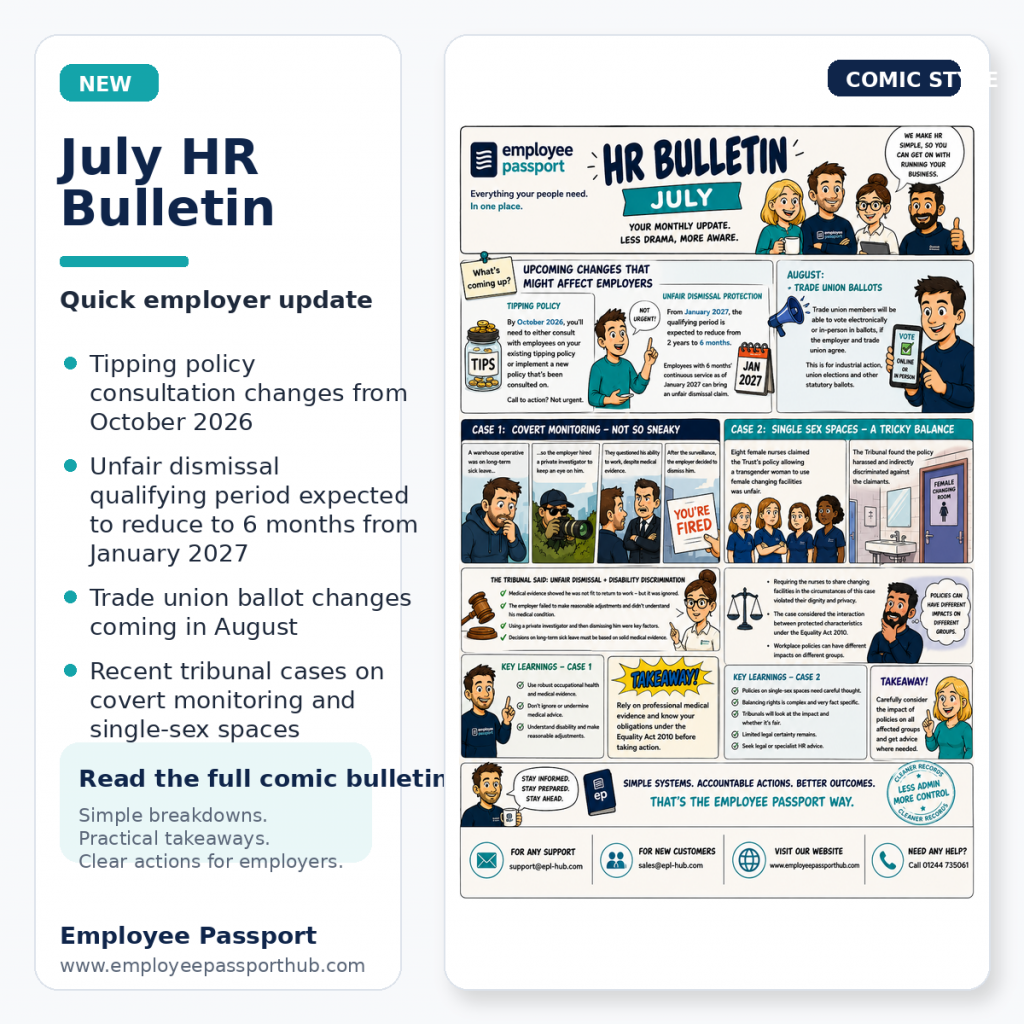
The July Employee Passport HR Bulletin highlighted a case involving a warehouse employee who had been absent on long-term sick leave.
According to the case summary, the employer instructed a private investigator to monitor the employee, questioned his ability to work and ultimately dismissed him. The tribunal found unfair dismissal and disability discrimination, with the employer’s treatment of medical evidence and its understanding of the employee’s condition forming important parts of the case (Employee Passport Limited, 2026).
The lesson is not that an employer must accept every absence without question.
Employers have the right to manage attendance. They can hold welfare meetings, seek medical information, obtain occupational health advice and investigate genuine concerns.
But suspicion is not evidence.
A manager saying, “I do not believe them”, is not a professional assessment.
Medical and occupational health evidence must be considered properly. Employers should also assess whether a condition could meet the legal definition of disability and whether reasonable adjustments may be required.
This is where accountability becomes very clear.
A responsible employer should be able to explain:
what information was obtained;
what medical or professional advice was considered;
what support or adjustments were explored;
what conversations took place;
why the final decision was considered reasonable.
Long-term absence should not be ignored indefinitely. Neither should an employee be treated unfairly because a manager has already decided what they believe.
Fairness requires evidence, process and an open mind.
Policies can affect people differently
The second case in the Employee Passport bulletin concerned a policy allowing a transgender woman to use female changing facilities.
The bulletin reported that eight female nurses challenged the arrangement. The tribunal found that the policy had harassed and indirectly discriminated against the claimants. The case illustrates the difficult interaction between protected characteristics, dignity and privacy under the Equality Act 2010 (Employee Passport Limited, 2026).
These are complex and highly sensitive situations.
Leaders should not pretend otherwise.
A policy may be written with good intentions and still affect different groups in different ways. Treating everybody identically does not always produce a fair outcome.
The responsible approach is to assess the particular workplace, listen to those affected, consider privacy and dignity, document the decision-making process and obtain specialist advice where necessary.
This is not an area for slogans, personal opinions or rushed decisions.
It is an area for calm leadership.
You do not need to agree with every viewpoint to treat people with dignity. You do need to understand your legal responsibilities and consider the practical effect of your decisions.
Political change does not remove commercial reality
There is a danger that employment reform becomes a political argument rather than a practical business issue.
For an SME, the commercial questions are straightforward.
How much will the change cost?
Do our systems reflect the current rules?
Are our managers competent?
Are our policies still accurate?
Could we demonstrate a fair process if challenged?
Will additional risk make us more cautious about recruitment?
CIPD research has warned that aspects of the Employment Rights Act could increase employment costs, weaken permanent job creation and contribute to workplace conflict if implementation is not managed carefully (CIPD, 2026c).
That concern should not be dismissed.
Good employment protection and commercial growth should not be treated as opposing ideas. Responsible businesses want to treat people properly. They also need sufficient confidence and flexibility to recruit, invest and grow.
The answer is not to avoid employing people.
The answer is to employ people properly.
Where Employee Passport fits
This is where Employee Passport Limited has a clear place in the changing landscape.
The Government creates the legislation.
Acas, CIPD and other professional bodies explain the principles and good practice.
Legal specialists advise on complex cases.
Employee Passport helps SMEs turn those responsibilities into practical, everyday action.
That means:
clear and accessible policies;
organised employee records;
visible review dates;
better absence management;
structured probation processes;
HR and health and safety information in one place;
evidence that decisions and actions have been recorded.
Employee Passport is not about creating more administration.
It is about controlling the administration that already exists.
It is about helping business owners identify gaps before those gaps become claims, disputes, penalties or damaged working relationships.
A system cannot make a difficult leadership decision for you.
It can make sure you have the information, records and reminders needed to make that decision properly.
Do not wait for the problem
More change is coming.
Electronic and workplace voting methods for statutory trade union ballots are expected to be introduced from August 2026, subject to parliamentary approval of the relevant secondary legislation and code of practice (UK Government, 2026f).
The reduction of the unfair dismissal qualifying period and the removal of the compensatory award cap are planned for January 2027. Other reforms will continue to be implemented in phases, and some of the detail will be shaped through further regulations and guidance (UK Government, 2026a; CIPD, 2026a).
SME leaders cannot control the political timetable.
They can control their preparation.
Review your employment contracts. Check your sickness and family-leave procedures. Strengthen probation arrangements. Train managers. Record important conversations. Use medical evidence properly. Review policies that affect protected groups. Make sure documents are current, available and consistently applied.
Do not treat compliance as a folder on a shelf.
It is part of leadership.
It is part of risk management.
It is part of building a good business.
The law is moving. Accountability means moving with it.
References
Acas (2026a) Statutory sick pay. Available at: Acas website, ‘Checking sick pay: Statutory sick pay’ (Accessed: 13 July 2026).
Acas (2026b) Taking paternity leave. Available at: Acas website, ‘Paternity leave and pay’ (Accessed: 13 July 2026).
Acas (2026c) Unfair dismissal. Available at: Acas website, ‘Dismissals: Unfair dismissal’ (Accessed: 13 July 2026).
CIPD (2026a) Tracking law changes: Employment Rights Act 2025. London: Chartered Institute of Personnel and Development. Available at: CIPD website (Accessed: 13 July 2026).
CIPD (2026b) UK employment law changes June 2026: Unfair dismissal changes. London: Chartered Institute of Personnel and Development. Available at: CIPD website (Accessed: 13 July 2026).
CIPD (2026c) Employment Rights Act risks being a handbrake on hiring, new research finds. London: Chartered Institute of Personnel and Development. Available at: CIPD website (Accessed: 13 July 2026).
Employee Passport Limited (2026) HR Bulletin: July 2026. Chester: Employee Passport Limited.
UK Government (2026a) Plan to Make Work Pay and Employment Rights Act: timeline update. London: Department for Business and Trade. Available at: GOV.UK (Accessed: 13 July 2026).
UK Government (2026b) Statutory Sick Pay changes. London: Department for Business and Trade. Available at: Business.gov.uk (Accessed: 13 July 2026).
UK Government (2026c) New employment rights: guidance for businesses and workers. London: Department for Business and Trade. Available at: Business.gov.uk (Accessed: 13 July 2026).
UK Government (2026d) Millions of workers get new access to sick pay and parental leave. London: Department for Business and Trade. Available at: GOV.UK (Accessed: 13 July 2026).
UK Government (2026e) Unfair dismissal changes: summary of stakeholder roundtables. London: Department for Business and Trade. Available at: GOV.UK (Accessed: 13 July 2026).
UK Government (2026f) Draft code of practice on electronic and workplace balloting for statutory union ballots. London: Department for Business and Trade. Available at: GOV.UK (Accessed: 13 July 2026).